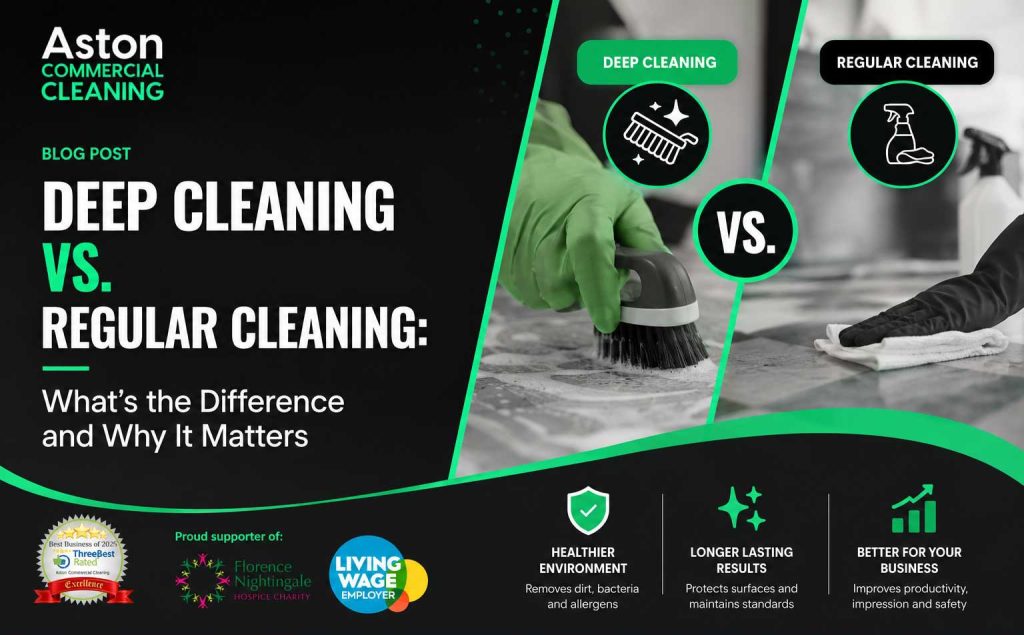
If you manage a commercial premises — whether that’s an office, warehouse, school, or medical facility — you’ve probably come across both terms. But what’s the actual difference between a deep clean and regular cleaning? And how do you know which one your business needs?
In this article, we break it down clearly, so you can make the right decision for your premises and your team.
What Is Regular Commercial Cleaning?
Regular cleaning — sometimes called maintenance cleaning or routine cleaning — is exactly what it sounds like. It’s the day-to-day or week-to-week cleaning that keeps your premises looking presentable and hygienic on a consistent basis.
For most commercial premises, regular cleaning typically includes:
- Vacuuming and mopping floors
- Emptying bins and replacing liners
- Wiping down desks, surfaces, and communal areas
- Cleaning and sanitising toilets and washrooms
- Restocking consumables such as soap, paper towels, and toilet roll
- Kitchen and breakout area cleaning — wiping counters, cleaning appliances externally, washing up
The goal of regular cleaning is consistency. It keeps your workspace clean for employees and visitors and prevents the build-up of dirt, bacteria, and mess over time.
For most offices and commercial spaces, regular cleaning is scheduled daily, three times a week, or weekly depending on footfall and the nature of the premises.
What Is a Deep Clean?
A deep clean goes significantly beyond the surface level. It’s a thorough, intensive clean that targets the areas regular cleaning doesn’t routinely reach — behind furniture, inside appliances, grout lines, air vents, skirting boards, light switches, door frames, and more.
A commercial deep clean typically includes everything in a regular clean, plus:
- Full scrubbing and descaling of washrooms and kitchen areas
- Cleaning inside ovens, microwaves, and fridges
- Steam cleaning or shampooing of carpets and upholstery
- High-level cleaning — lights, vents, ceiling edges, and cobwebs
- Cleaning behind and underneath furniture and equipment
- Disinfecting high-touch points such as light switches, door handles, and bannisters
- Window frames, ledges, and internal glass
- Floor stripping and re-sealing (for hard floors where required)
A deep clean is restorative. It brings a premises back to a high standard that regular maintenance cleaning then keeps in place.
What’s the Key Difference?
The simplest way to think about it is this:
- Regular cleaning maintains a standard
- Deep cleaning restores or elevates a standard
Neither replaces the other. They work together. A deep clean without regular maintenance cleaning means your premises quickly deteriorates again. Regular maintenance cleaning without periodic deep cleaning means hidden grime, bacteria, and dirt build up in areas that aren’t being reached.
How Often Does a Commercial Premises Need a Deep Clean?
There’s no one-size-fits-all answer — it depends on the type of premises, the level of footfall, and the nature of the work carried out there.
As a general guide:
| Premises Type | Recommended Deep Clean Frequency |
|---|---|
| Office (low–medium footfall) | Every 3–6 months |
| Office (high footfall, shared workspace) | Every 1–3 months |
| Warehouse or industrial unit | Every 3–6 months |
| School or education setting | Every term (3x per year) |
| Medical or care setting | Monthly or more frequently |
| Restaurant or food production | Monthly minimum |
| Retail or customer-facing space | Every 1–3 months |
If your premises has never had a proper deep clean — or hasn’t had one in over 12 months — it’s likely overdue, regardless of how well regular cleaning is maintained.
Signs Your Commercial Premises Needs a Deep Clean
Not sure if it’s time to book one? Look out for these signs:
- Carpets look dull or feel compacted even after regular vacuuming
- Persistent odours in washrooms, kitchens, or communal areas
- Visible build-up around taps, grout lines, or appliances
- Dust accumulation on high surfaces, light fittings, or above cupboards
- Your washrooms don’t feel fresh no matter how often they’re cleaned
- You’re preparing for a new tenancy, a return to office, or a key client visit
- Staff are frequently raising concerns about the cleanliness of the premises
Can You Combine Both Services?
Absolutely — and for most businesses, this is the recommended approach.
The most effective cleaning programme combines regular scheduled cleaning throughout the week with a periodic deep clean at agreed intervals. This ensures your premises is always presentable for staff and visitors day-to-day, while also being thoroughly cleaned at a deeper level on a regular basis.
At Aston Commercial Cleaning, we provide both. We work with businesses across Buckinghamshire, Hertfordshire, and Bedfordshire to put together cleaning schedules that make sense for their premises — not just a one-size-fits-all contract.
If you’d like to discuss what combination is right for your business, get in touch for a free, no-obligation quote.
Summary: Deep Clean vs. Regular Clean at a Glance
| Regular Cleaning | Deep Cleaning | |
|---|---|---|
| Frequency | Daily, weekly, or regular schedule | Periodic (monthly, quarterly, or as needed) |
| Purpose | Maintain day-to-day hygiene | Restore and refresh to a higher standard |
| Areas covered | All visible surfaces and key areas | All areas including hard-to-reach and hidden spots |
| Time required | 1–4 hours typically | Several hours to a full day |
| Replaces the other? | No | No |
Both are important. Both serve a different purpose. And for most commercial premises, both are needed to maintain a genuinely clean, healthy, and professional working environment.
Aston Commercial Cleaning provides regular commercial cleaning, deep cleaning, and specialist cleaning services across Aylesbury, Milton Keynes, Hemel Hempstead, Watford, and surrounding areas. Request a free quote today.